Dunedin (727) 734-7611
Largo (727) 587-6667
St. Petersburg (727) 520-1818
1075 Main St. Dunedin, FL 34698
515 Missouri Avenue North Largo, FL 33770
3737 16th Street North St. Petersburg, FL 33704
The adult human body is made up of 206 bones, which perform like a structural scaffolding that helps support the body to move (or ambulate). And except for one neck bone (the hyoid bone), the rest of the bones connect to at least one additional bone. The junction/point where two bones lie adjacent to each other (whether they can move or not) is called a joint.
Most joints allow for and facilitate movement (i.e., locomotion) between the bones in your body. Ironically, the community of professionals often disagree on the exact number of joints in the human body based on a debatable definition. For the sake of this discussion, adults have around 350 joints.
What Does a Joint Consist of?
A joint has these components -
The human body’s joints are classified based on the joint’s range of motion and by the tissue that holds the nearby bones together (i.e., the joint’s histological basis). Healthcare and medical professionals classify joints into three primary categories –
There are six types of synovial joints in the human body -
A hinge joint, as its name implies, can open and close in only one direction – for example – your elbows or knees.
In this type of synovial joint, one bone with a rounded end fits into the indentation of another nearby bone. A ball and socket joint is quite versatile as it can rotate and turn in almost any direction. Some examples are your hips or shoulders.
Condyloid joints, similar to ball and socket joints with some rotation limitations, consist of two oval-shaped bones that fit together – examples include your wrist, toes, etc.
Saddle joints, which allow for movement in any direction but can’t rotate or twist, are formed when two curved bones meet- an example is where your thumb meets your hand.
Pivot joints allow for rotation without adjusting from their original position – an example is a pivot neck joint that lets you move from one side to the other.
Planar joints are formed when two mostly flat bones meet and move when one bone slides over the other – examples include the spine’s vertebrae and the wrist’s carpal bones.
The symptoms of a joint condition that a chiropractor can treat will vary but may include one or more of the following -
You use your joints whenever you do anything, from walking the dog to reading this article. If joint pain disrupts your life, contact a chiropractor near you today.
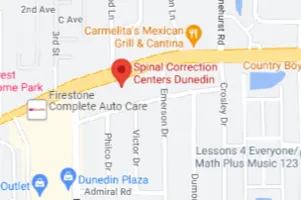 Dunedin
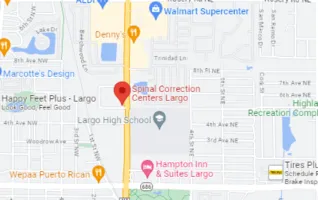 Largo
Largo515 Missouri Avenue North,
Largo, FL 33770
727-587-6667
Monday, Wednesday
8:00 AM -11:00 AM, 3:00 PM - 6:00PM
Friday
8:00 AM -11:00 AM
St. Petersburg3737 16th Street North,
St. Petersburg, FL 33704
727-520-1818
Monday, Wednesday, Thursday
8:00 AM - 12:00 PM, 2:00 PM - 6:00 PM
Tuesday
3:00 PM - 6:00 PM
Friday
8:00 AM - 11:00 AM
